
Loudoun County Arrest Warrants Explained
An arrest warrant gives an officer lawful power to bring someone before a court, and it only exists after a judicial officer finds probable cause. Virginia Code §19.2-71 spells out who may issue that process in Loudoun County: judges, court clerks, and magistrates. Section 19.2-72 adds an oath-based review and requires a written complaint for any felony. A magistrate who reviews a complaint can also set bail. From there, the return court tracks the case status. An online case result may show only part of that process, so the clerk's answer beats the screen.
How Loudoun County Arrest Warrants Are Issued
Everything starts with a sworn complaint. The complainant gives information under oath, and a Loudoun County magistrate or another authorized officer then decides two things: whether probable cause exists, and whether the matter calls for a warrant or a summons. If a warrant issues, it names the offense and directs an officer to bring the person before a court. Felony complaints must be in writing under state law. A magistrate also faces limits on issuing a felony warrant from a private citizen's complaint without prior authorization. Read the signed process closely. Ask which court receives it, since that court controls what happens next.
Inside a Loudoun County Arrest Warrant
Virginia warrant forms carry a case or process number, the court, the charge, the issuing authority, the issue date, the return court, and any bail direction that was set. Service information may name an agency and officer. Loudoun County publishes no public warrant-number format or complete active-status sample, so use the exact identifier printed on the court paper rather than a guessed pattern. One file can hold several separate items: the service return, the case entry, and a later recall order.
| Case or process number | Copy the court’s exact number from the paper or ask the clerk. |
|---|---|
| Charge | The offense named in the warrant, distinct from the reason a later capias issued. |
| Issuing official | May be a magistrate, judge, or authorized clerk. |
| Return court | The court that will receive the case or process. |
| Bail direction | Terms set by a magistrate or judge, if specified. |
| Serving agency | The agency assigned to execute or return the process. |
| Later action | Service, recall, quash, and the next hearing may appear as separate events. |
Serving Arrest Warrants in Loudoun County
Several agencies serve warrants in Loudoun County. LCSO Court Services handles courthouse security along with civil and criminal document enforcement, while Leesburg, Purcellville, and Middleburg each have town police departments. Virginia State Police and other authorized officers may also serve process, and the serving agency is not always the court that issued it. For a service question, LCSO's ECC lists Warrants Control among its duties and publishes 703-777-1021 for non-emergency routing. Call the issuing clerk for current court status or a recall. Save 911 for true emergencies, not routine checks.
Loudoun County Warrant Service Has Several Agencies
A Loudoun County warrant can travel a long path, from a magistrate's complaint review to a court docket to an assigned serving agency. A town police department can identify a report or summons it handled, but the return court directs any later appearance or recall. LCSO's internal systems are not open public search tools. The ECC page lists Warrants Control and VCIN/NCIC among its duties. That supports an enforcement-routing call, not a downloadable county warrant list.
Comparing Arrest, Summons, and Bench Warrants
The labels matter. A summons asks a person to appear or respond, while an arrest warrant authorizes custody. A bench or FTA process follows a missed court obligation or a violation, and Virginia forms may call it a capias or show cause. None of these labels tells you whether process remains active in Loudoun County. Check the court and case number before deciding what event comes next.
| Process | Why It May Issue | First Contact |
|---|---|---|
| Arrest warrant | Probable cause to bring a person before court | Issuing magistrate or return court |
| Summons | Notice to appear or respond where permitted | Court named on the notice |
| Bench or FTA process | Missed appearance or another court obligation | Court with the underlying case |
Loudoun Arrest Warrant Issuance Starts With an Oath
Issuance in Loudoun County begins with an oath. The magistrate's office describes independent review of complaints from officers, deputies, sheriffs, and citizens, and a written statement, witness information, and the probable-cause decision form the start of the process. The Loudoun Magistrate's Office lists arrest and search warrants among its duties. Remember that issuance is not service. A warrant can sit with an officer, be served later, or go back to the court. Confirm current status with the court or a lawyer.
Search Warrant Files Use a Separate Loudoun Route
A search warrant is a different animal. It concerns a described place, person, or thing and the evidence sought there, not a person's arrest status, so it is not an arrest-warrant search product. Loudoun County directs search-warrant affidavits and returns to Circuit Criminal Division after issuance, and returns may be arranged virtually. The Loudoun County search-warrant process page describes that local filing route. Ask Circuit Criminal Division at 703-771-5610 about a filed return. Virginia Code §19.2-54 allows temporary sealing in some cases.
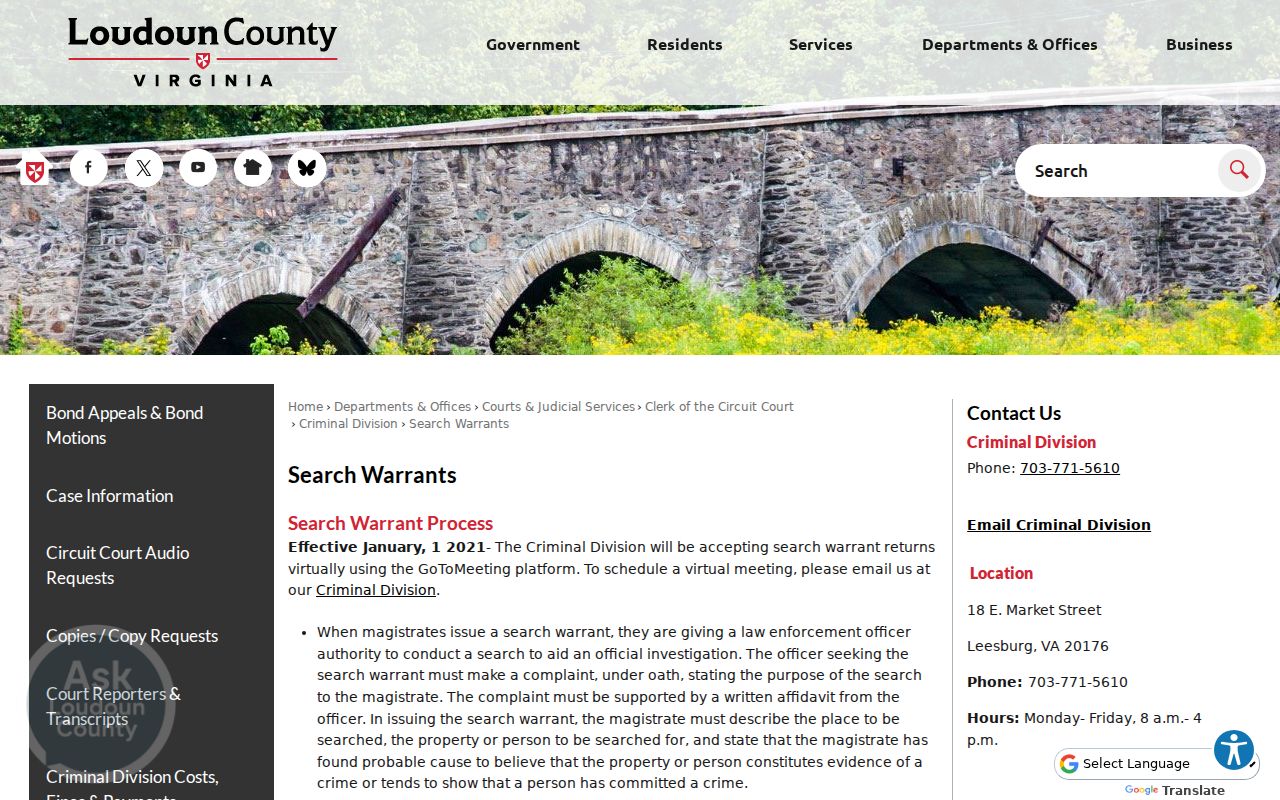
Read the Loudoun search-warrant process for that separate file route.
Bond Is Set by a Loudoun Magistrate or Judge
Who sets bond in Loudoun County? A magistrate or a judge, according to Adult Detention Center information. The public county materials give no universal warrant bond schedule, no accepted payment list, and no walk-in bond-window hours, so never assume a charge carries a fixed amount. Call the verified ADC or LCSO number before you travel. Ask whether your question belongs with the court, the magistrate, or the facility, and keep the case number and any bond order close at hand.
Before Acting on an Arrest Warrant in Loudoun
Think an arrest warrant is active in Loudoun County? Contact a defense lawyer and the issuing court before you show up anywhere. Ask whether the court lets counsel arrange a motion or setting, where the person must report, what bond direction applies, and how the court will confirm the process afterward. No public page promises a safe surrender, a same-day recall, or a universal walk-in procedure. The general resolution steps are on the Loudoun warrant overview. One more thing: posting bond may address custody, but the criminal case itself continues.
Do not rely on a caller’s demand. Hang up, then verify through the court or LCSO using a number published on its official website.